Why Most Trade Show Programs Fail Long Before the Doors Open
Trade shows often promise a powerful platform for brands to connect with customers, generate leads, and build market presence. Yet, many trade show programs fail before the event even begins. The problem is not the exhibit design or the branding. Instead, failure usually stems from operational breakdowns and strategic missteps that happen well before the first visitor arrives.
This article explores why most trade show programs stumble early, what hidden costs reactive exhibiting creates, and how top brands engineer success by aligning their programs from the start. It also introduces a disciplined methodology to help executives and teams build trade show programs that deliver measurable results.
The Illusion of a “Successful Exhibit”
At first glance, a busy exhibit space filled with visitors looks like a win. Crowds suggest interest, and activity feels productive. But busyness alone does not equal success.
Many companies confuse being busy with being effective.
A structure can attract visitors but still fail to meet key business goals. Without clear objectives, it’s impossible to measure whether the right prospects are engaged or if the conversations lead to sales. The focus on design trends and eye-catching displays often overshadows the need for operational clarity.
Businesses have poured significant resources into creating visually impressive exhibit spaces, only to discover that while the area was crowded during the event, post-event analysis frequently showed a scarcity of qualified leads.
Was the design at fault? Was the messaging ineffective?
If the program lacked specific KPIs and a well-defined audience strategy, their team focused on quantity rather than quality.
Why Busy Does Not Always Mean Productive
Trade shows demand significant investment in time, money, and resources. When teams focus on keeping the exhibit busy, they often overlook the quality of interactions and alignment with business goals.
Common reasons why most trade show programs fail:
Unclear KPIs: Without specific, measurable goals, teams cannot track success or adjust tactics.
Stakeholder misalignment: Marketing, sales, and operations often have conflicting priorities.
Procurement-led decisions: Cost-driven choices can undermine program effectiveness.
Late approvals: Delays in content, staffing, or logistics disrupt preparation.
Staffing breakdowns: Inadequate training or unclear roles reduce engagement quality.
No audience strategy: Random visitor engagement wastes time and misses target prospects.
Disconnected sales follow-up: Leads collected at the show fail to convert without coordinated follow-up.
These issues create a reactive environment where teams scramble to fix problems during the event instead of executing a planned strategy.
The Hidden Cost of Reactive Exhibiting
Reactive exhibiting can significantly drain both budgets and team morale. When teams are forced to respond to problems on the fly, they often waste valuable resources on last-minute fixes and miss opportunities to positively influence outcomes. This reactive approach can lead to a series of hidden costs that impact overall trade show performance.
Delayed approvals, rushed design changes, technical glitches, unclear messaging, and inconsistent follow-ups can complicate the trade-show lifecycle. When these components are handled by multiple vendors and suppliers, the likelihood of miscommunication and inefficiency increases. This fragmentation can result in a disappointing return on investment (ROI), even when show traffic is high.
Beyond the immediate financial losses, reactive exhibiting programs can damage brand reputation and frustrate stakeholders. The disjointed nature of outsourcing each piece to separate vendors makes it difficult to justify future trade show budgets, perpetuating a cycle of underperformance. By choosing a comprehensive partner, companies can break this cycle and foster a more effective, cohesive exhibiting strategy.
The Case for a Unified Partner
To enhance exhibit performance and maximize ROI, firms should consider working with a partner that manages everything under one roof.
Working with a single, single-source team streamlines the entire exhibit lifecycle by aligning every phase from initial concept through final execution. Housing design, custom fabrication, and comprehensive project management under one roof creates a natural system of strategic foresight and proactive risk management. It eliminates communication gaps between separate vendors and protects your budget from last-minute surcharges or unexpected line items on your final invoice.
This unified approach ensures that critical operational phases, such as structural engineering, technology testing, and immersive product activations, are fully pre-staged and vetted before public unveiling.
By partnering with a cohesive team, you can engineer spatial storytelling environments where every structural choice deliberately reinforces your technical narrative. This strategic alignment does more than just fill square footage; it deepens attendee engagement while keeping your core branding objectives front and center.
Ultimately, an end-to-end partnership shifts your exhibit program from a logistical burden to a high-performing sales environment. By focusing on measurable results and lead quality rather than just general traffic, you deliver predictable, repeatable outcomes that drive lasting corporate value.
Immersive Experiences and Targeted Audience Engagement
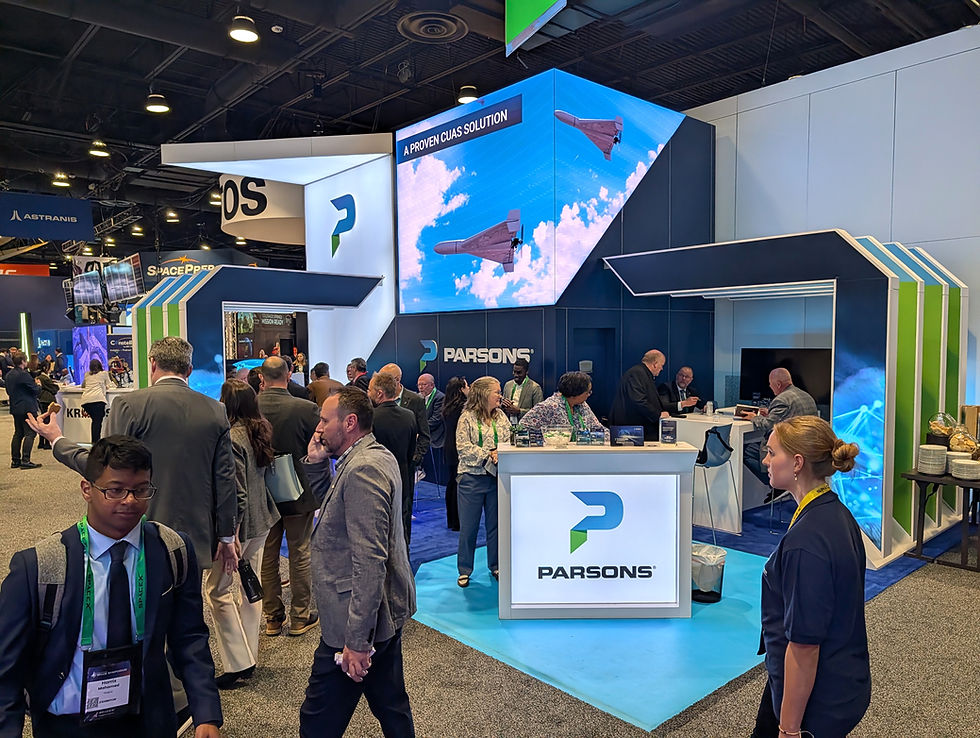
Trade shows are high-stakes business initiatives that require immersive, human-centered spaces to truly resonate. By engineering purposeful environments, brands can move past surface-level interactions and forge deep, face-to-face connections with key decision-makers.
Targeted Audience Strategy
Top brands treat floor space as a precision marketing tool, implementing audience strategies built entirely around specific goals. Rather than designing for a generic crowd, they use deep audience segmentation to tailor every spatial element and message to the exact decision-makers they need to reach. This disciplined focus moves past casual booth traffic, significantly accelerating high-value engagement and pipeline conversion rates.
Cost Management & Value Optimization
Maximizing impact requires balancing bold, innovative design with strict fiscal discipline. Forward-thinking brands avoid the trap of single-use structures by investing in highly adaptable, premium component architectures. This strategic approach optimizes the marketing budget, ensuring that every custom asset is engineered for durability and multifunctionality without ever compromising the brand’s visual authority.
Modular Architecture Solutions
A sophisticated modular system allows an exhibit to effortlessly adapt to different square footage footprints and venue constraints without ever diluting your brand narrative. By engineering a scalable component architecture, organizations can fluidly reconfigure their layout for varying audience sizes and hall restrictions across an entire annual event calendar. This logistical agility ensures a premium, consistent presence at every single stop while drastically reducing the need for costly, single-use custom builds.
By weaving these disciplines into a cohesive strategy, organizations transform their exhibit programs from unpredictable logistical hurdles into high-performing corporate assets.
Success on the show floor isn't about chasing the latest design trends or spending the most capital;
It is about establishing an intentional, repeatable lifecycle that balances bold creative discovery with absolute operational control.
When your spatial storytelling, target audience strategy, and modular architecture work in perfect harmony, your brand doesn't just fill a space, it commands it.
The RES Methodology for Program Alignment
At RES, we believe a great exhibit should be a high-performance environment designed to move your pipeline forward, rather than just an exercise in filling square footage.
True Engineered Wonder happens at the intersection of bold, human-centered spatial storytelling and absolute operational discipline.
To help teams avoid common logistical failure points, we operate as a collaborative extension of your staff, a dedicated partner, not a transactional build vendor. We align every program around our core pillars:
Strategic Spatial Storytelling
We begin with a deep, collaborative discovery process to unearth your brand’s unique narrative. Our focus is on designing immersive, human-centered environments where every architectural element, from lighting to structural flow, deliberately tells your story. By anchoring your physical presence in authentic design, we naturally drive the meaningful engagement that translates into measurable business outcomes.
Engaged Stakeholders
We break down corporate silos by bringing marketing, sales, procurement, and operations into a unified conversation from day one, ensuring total strategic alignment across your organization.
Structured Processes
We implement rigorous timelines, pre-staging quality control protocols, and transparent communication channels. By handling the entire end-to-end lifecycle under one roof, we eliminate last-minute surcharges and take the logistical burden entirely off your shoulders.
On-Site Leadership & Advocacy
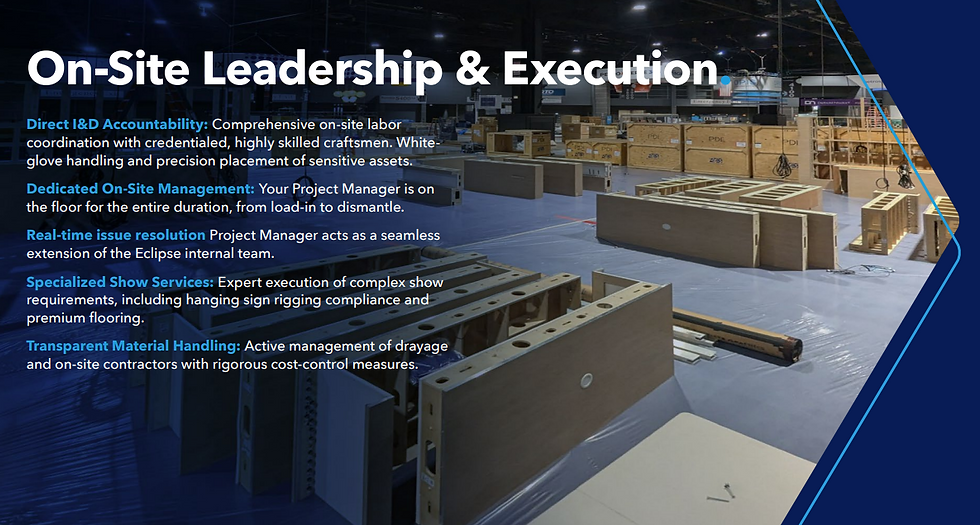
True partnership is defined during show week when the stakes are highest. Our dedicated show-site management team stays with you throughout the entire event. Our on-site team is there to navigate union labor, I&D, facility logistics, and live technical testing. We shield your team from operational friction, ensuring your environment performs flawlessly from the opening keynote to the final wrap.
Operational Stewardship & Lifecycle Care
Our partnership doesn’t end when the final crate is packed. We handle the entire post-show breakdown, freight coordination, safe transport, and storage to our 125,000 sq. ft. facility. Our team conducts a rigorous, full inspection of your exhibit and valuable company assets, performing any necessary maintenance to ensure every structural and technical component is kept in pristine condition, perfectly prepped and ready for the next stop on your event calendar.
By weaving creative discovery, absolute operational discipline, and continuous asset stewardship into a single lifecycle methodology, we eliminate the traditional chaos of trade show execution. We don't just build structures; we engineer the predictable, repeatable environments that protect your marketing investments and give your brand the room to perform.
Why This Matters Strategically
Trade show programs represent one of the most significant investments in your corporate marketing portfolio.
When an exhibit strategy fails due to poor planning or fragmented execution, you lose far more than your budget, you lose market momentum, competitive advantage, and critical face-to-face opportunities with key decision-makers.
By addressing these operational failure points upfront through a unified strategy, forward-thinking organizations achieve an entirely different standard of exhibit performance.
This disciplined approach aligns with the modern vision of corporate trade show management: designing spaces to deliver measurable results, not just fleeting visual appeal.
It is time to move past the transactional vendor model and the logistical friction that comes with it. Your brand deserves an extension of your own team, an operational partner dedicated to protecting your assets and amplifying your brand story.
